 Yard
| Material | Typical weight per cubic yard | Value used in our calculators |
|---|---|---|
| Gravel (general) | About 1.2–1.5 tons (2,400–3,000 lb) | 1.4 tons |
| Pea gravel | About 1.3–1.5 tons | 1.4 tons |
| Crushed stone / base | About 1.3–1.5 tons | 1.4 tons |
| Sand (dry) | About 1.2–1.4 tons | 1.35 tons |
| Topsoil | About 1.0–1.3 tons | 1.1 tons |
| Fill dirt | About 1.1–1.4 tons | 1.2 tons |
| Wood mulch | Much lighter – roughly 400–800 lb | Sold by volume |
| Asphalt (compacted hot mix) | About 1.96 tons (at 145 lb/ft³) | 145 lb/ft³ |
| Concrete | Roughly 2 tons (about 4,000 lb) | – |
These are typical ranges, not exact figures. Moisture can add a lot of weight, and every quarry's material is different. Ask your supplier for the conversion they use when you order by the ton.
How to convert yards to tons
Cubic yards = Tons ÷ tons per cubic yard
Example: 5 cubic yards of gravel × 1.4 = 7 tons. 3 tons of topsoil ÷ 1.1 = about 2.7 cubic yards.
Can my truck carry it?
A cubic yard of gravel can weigh more than a ton – often more than a typical pickup's payload. Check the payload rating on your vehicle's door sticker or manual before loading, and spread heavy material over several trips if needed.
Calculators that use these values
Gravel · Topsoil · Fill dirt · Paver base & sand · Asphalt · Cubic yards
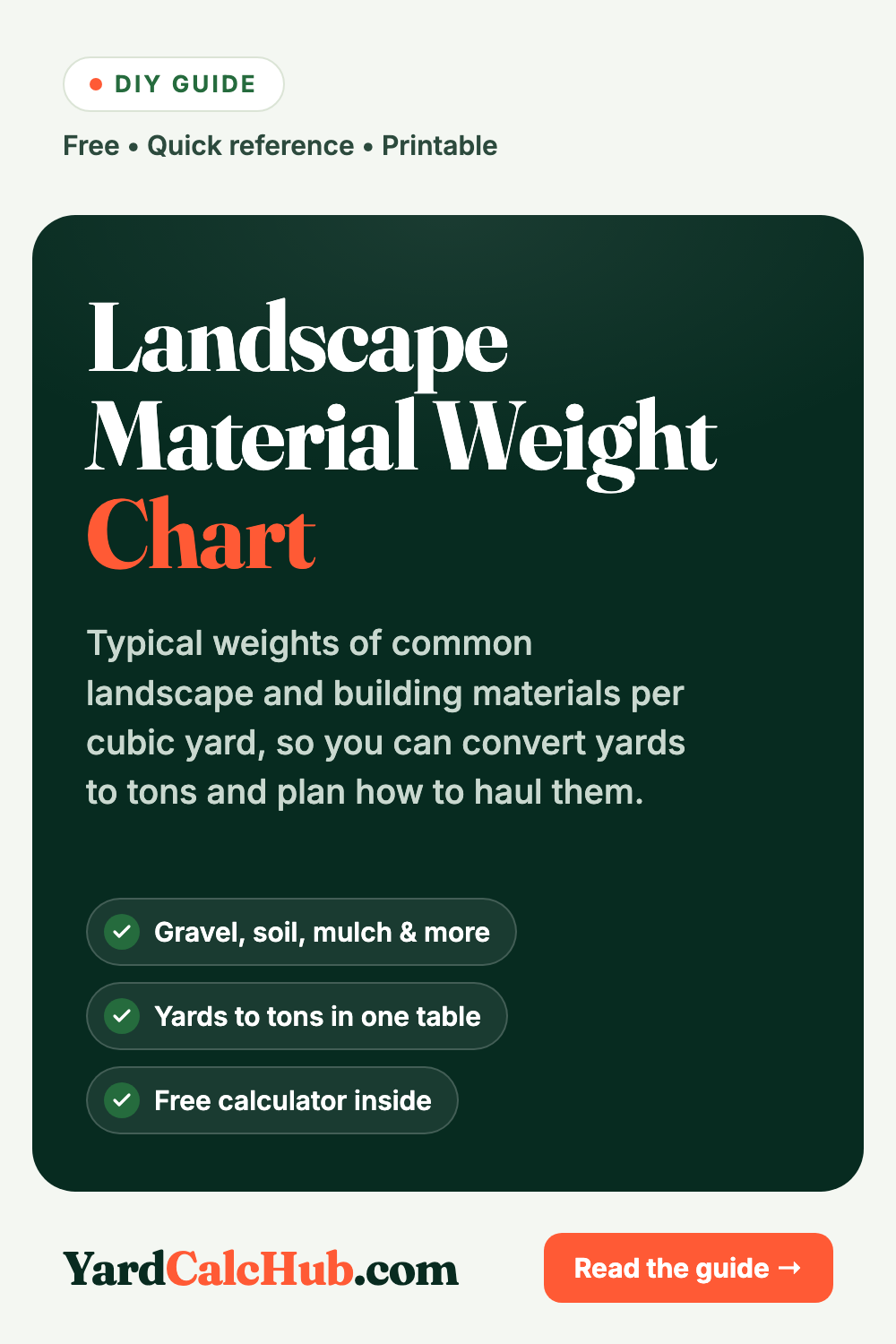
Quick answer: how much does a cubic yard weigh?
It depends on the material. A cubic yard of gravel weighs about 1.4 tons, topsoil about 1.1 tons, dry sand about 1.35 tons, and wood mulch only about 0.2 to 0.4 tons (400–800 lb). Asphalt is the heaviest common yard material at about 1.96 tons per cubic yard, and concrete is about 2 tons. These are the same defaults our calculators use. Wet material always weighs more than dry material, so treat every figure on this page as a planning estimate and confirm the supplier's figure before you order.
Weight by material
Gravel. General gravel, pea gravel and crushed stone all sit near 1.4 tons per cubic yard, but the exact figure moves with the stone: rounded pea gravel is lighter and looser, angular crushed stone packs tighter, and crusher run with fines compacts hardest. If your supplier sells by the ton, use their density, not this page's default.
Sand. Dry sand is about 1.2 to 1.4 tons per cubic yard. Wet sand can weigh noticeably more because water fills the gaps between grains, so a yard of sand delivered after rain can push past the dry figure. For paver bedding and pipe bedding, confirm whether the supplier quotes dry or damp weight.
Topsoil and fill dirt. Topsoil is about 1.0 to 1.3 tons per cubic yard when fairly dry; screened topsoil is lighter than unscreened soil with clay and stones. Fill dirt is about 1.1 to 1.4 tons, and it gets heavier as it compacts — the 1.25 to 1.30 compaction factor our fill dirt calculator applies is the reason a loose yard becomes less than a yard once it is graded and rolled.
Mulch. Mulch is sold by volume, not weight, because it is so light: wood mulch runs roughly 400 to 800 lb per cubic yard depending on type and moisture. That is why a cubic yard of mulch costs far less to haul than a cubic yard of stone, and why mulch is usually ordered in yards or bags rather than tons.
Asphalt and concrete. Compacted hot mix asphalt is about 1.96 tons per cubic yard at 145 lb per cubic foot. Concrete is roughly 2 tons per cubic yard, about 4,000 lb. Both are ordered by weight or by volume depending on the supplier, so check which unit your quote uses before comparing prices.
Yards to tons: more worked examples
6 cubic yards of sand × 1.35 = 8.1 tons. 8 cubic yards of fill dirt × 1.2 = 9.6 tons. 1 ton of gravel ÷ 1.4 = about 0.71 cubic yards. 12 cubic yards of topsoil × 1.1 = 13.2 tons. Run the same arithmetic with your supplier's density whenever it differs from the defaults above.
How many tons can your truck carry?
Check the payload rating on the driver's door sticker or in the manual before you load, and never guess from the truck's name: a "half-ton" badge is a class name, not a payload promise. A single cubic yard of gravel at about 2,800 lb is more than many pickups are rated to carry, so heavy stone usually means several trips, a dump trailer, or delivery by the supplier. Spread the load evenly, keep it below the rated payload, and ask the supplier what size truck they deliver with so the driveway or street can take it.
Why the same material weighs different amounts
Three things move the number: moisture, compaction and gradation. Wet stone and soil weigh more than dry. Compacted base weighs more per yard than the same material loose, because air gaps are pressed out. And fine, well-graded material packs denser than clean, open-graded stone of the same rock. That is why two suppliers can quote different tons for the same cubic yards without either being wrong — each is describing their own product at their own moisture and compaction.
Using these weights in your project
Building a driveway? The gravel driveway layers guide shows base depths in inches, which you can convert to tons with the chart above.
Ordering soil? Our guide on how much topsoil you need pairs the depth math with these weight figures.
Pouring a slab? See how many bags of concrete you need and match bag counts to total weight.
Frequently Asked Questions
How much does a yard of gravel weigh?
Typically about 1.2–1.5 tons; our calculators use 1.4 tons as a default.
How much does a yard of topsoil weigh?
Often about 1.0–1.3 tons when fairly dry, more when wet.
How much does a yard of mulch weigh?
Much less than stone or soil – roughly 400–800 lb for wood mulch, depending on type and moisture.