 Yard
YardWhy build a gravel driveway in layers?
A gravel driveway is not one material poured to depth. It is a stack of layers, each with a different stone size and a different job. Large stone at the bottom spreads the weight of vehicles and lets water drain away. Medium stone locks into it, and fine stone with dust on top packs into a smooth, firm surface. Skip the layers and use one stone throughout, and you get ruts, potholes and gravel that sinks into the soil after the first wet winter.
The three layers
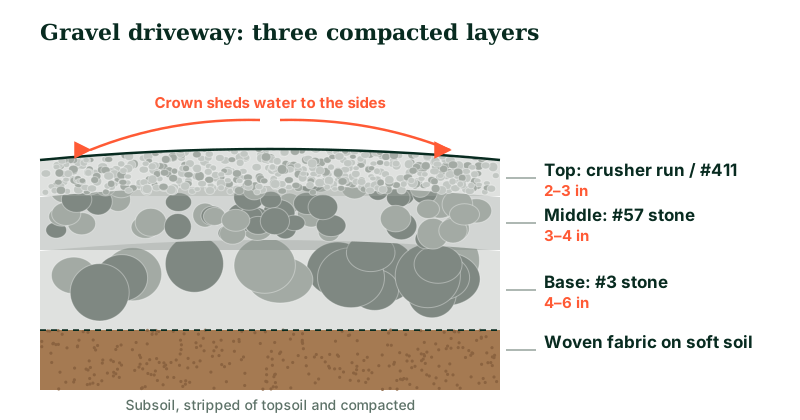
| Layer | Typical material | Typical depth | Job |
|---|---|---|---|
| Base | Large crushed stone (often sold as #3 stone, about 1½–2½ in) | 4–6 in | Spreads the load and drains water |
| Middle | Medium crushed stone (often #57, about ½–1 in) | 3–4 in | Locks into the base and adds strength |
| Top | Crusher run / #411 / dense-graded aggregate with fines | 2–3 in | Compacts into a smooth driving surface |
Stone names and numbers vary by region and supplier. Describe the use to your supplier ("driveway base", "top dressing") and ask what they recommend.
Tonnage example: 60 × 10 ft driveway
A single-lane driveway is usually 10–12 ft wide. For a 60 × 10 ft driveway (600 sq ft), using 1.4 tons per cubic yard for every layer:
| Layer | Depth | Cubic yards | Tons (at 1.4 t/yd³) |
|---|---|---|---|
| Base | 6 in | 11.11 | ≈ 15.6 |
| Middle | 4 in | 7.41 | ≈ 10.4 |
| Top | 2 in | 3.70 | ≈ 5.2 |
| Total | 12 in | 22.22 | ≈ 31.1 |
Add about 10% for compaction and spreading – roughly 24.4 cubic yards or 34 tons in all. Crusher run with lots of fines can weigh 1.5 tons per yard or more, so ask your supplier for their figure. Run each layer separately in the gravel calculator; it also counts truckloads.
Prepare the ground first
The layers are only as good as the soil under them. Strip the topsoil, grass and roots – organic material rots and leaves soft spots – and dig down to firm subsoil. Roll or compact the subgrade before any stone goes down. On soft, clay or wet ground, lay a woven geotextile fabric over the subgrade. It keeps the base stone from sinking into the mud and the mud from working up into the stone, and it often lets you use less base rock.
Crown and drainage
Water is the main enemy of a gravel driveway. Shape the surface with a crown – higher in the middle than at the edges – so rain runs off to the sides instead of sitting in ruts. A fall of about ½ inch per foot from the center to each edge (around 4%) is a common target for gravel. On a slope, add shallow ditches or swales along the sides, and a culvert where the driveway crosses a ditch. Build the crown into each layer, not just the top dressing, so it does not wash flat.
Compact in lifts
Spread each layer in lifts no thicker than about 4–6 inches and compact each lift with a plate compactor or roller before adding the next. A 6 inch base may need two passes of spreading and compacting. Lightly dampening dry stone helps it pack. Compacting only the finished surface leaves the lower layers loose, and they settle under the first heavy truck.
Step-by-step build
- Mark the driveway and call 811 to locate buried utilities before digging.
- Remove topsoil and vegetation down to firm subsoil, typically 8–12 inches.
- Grade the subgrade with a crown or cross-slope and compact it.
- Lay woven geotextile on soft or wet soil, overlapping the seams.
- Spread and compact the base rock in lifts.
- Spread and compact the middle layer.
- Spread the top layer, shape the crown and compact it.
- Add edging or a defined shoulder so the stone stays in place.
Common problems and how to fix them
- Ruts in the wheel tracks usually mean a thin or soft base. Rake the ruts out, add base stone where it has sunk, compact it, then top-dress. If ruts return every season, the subgrade needs fabric or more base.
- Potholes start where water sits. Dig out the loose material to firm stone, fill in thin layers of the same stone, tamp each one, and fix the crown or drainage that let water pool.
- Washboarding (a rippled surface) comes from loose, round top stone and traffic speed. Re-grade the surface and switch to an angular top stone with fines, such as crusher run.
- Stone spreading onto the lawn means there is no edge. Add steel or timber edging, or a defined shoulder of larger stone.
- Weeds grow in fines and debris. Keep the surface raked and topped up; a dense, well-compacted top layer gives weeds little room.
Maintenance
Even a well-built driveway needs care. Rake or drag the surface to fill ruts before they become potholes, keep the crown and side ditches clear, and add a thin top-up of crusher run every year or two – typically 1–2 inches. For a top-up, enter that depth in the gravel calculator. Fill potholes by digging out loose material, filling with the same stone and tamping it in layers.
Ways to save money
- Use recycled concrete for the base layer where it is available – it compacts well and is often cheaper than virgin stone.
- Order full truckloads to avoid short-load fees; see the bag vs bulk guide.
- Use fabric on soft ground to reduce how much base you need.
- Get the drainage right first. It is the cheapest way to avoid rebuilding the driveway in a few years.
For long or steep driveways, or soft and wet ground, get advice from a local contractor. For a paved finish over the same base, see the asphalt calculator or the paver calculator.
Frequently Asked Questions
How deep should a gravel driveway be?
A new driveway is usually 8–12 inches deep in three layers: 4–6 inches of base rock, 3–4 inches of middle stone and 2–3 inches of crusher run on top. Use the gravel calculator for each layer.
How many tons of gravel for a 60 ft driveway?
A 60 × 10 ft driveway built 12 inches deep needs about 22.2 cubic yards – roughly 31 tons at 1.4 t/yd³, or about 34 tons with 10% extra.
What is the best top layer for a gravel driveway?
A compactable stone with fines, such as crusher run or #411, packs into a firm surface. Round stone like pea gravel rolls under tires and is better for paths.
How wide should a gravel driveway be?
A single-lane driveway is usually 10–12 ft wide, and a two-car driveway 20–24 ft. Add a little extra on curves and where the driveway meets the road so tires stay on the stone. Wider driveways need proportionally more stone in every layer – enter the full width in the gravel calculator for each layer.
Do I need fabric under a gravel driveway?
On soft, clay or wet soil, yes – a woven geotextile stops the stone sinking and the mud rising. On firm, well-drained ground it is optional.