 Yard
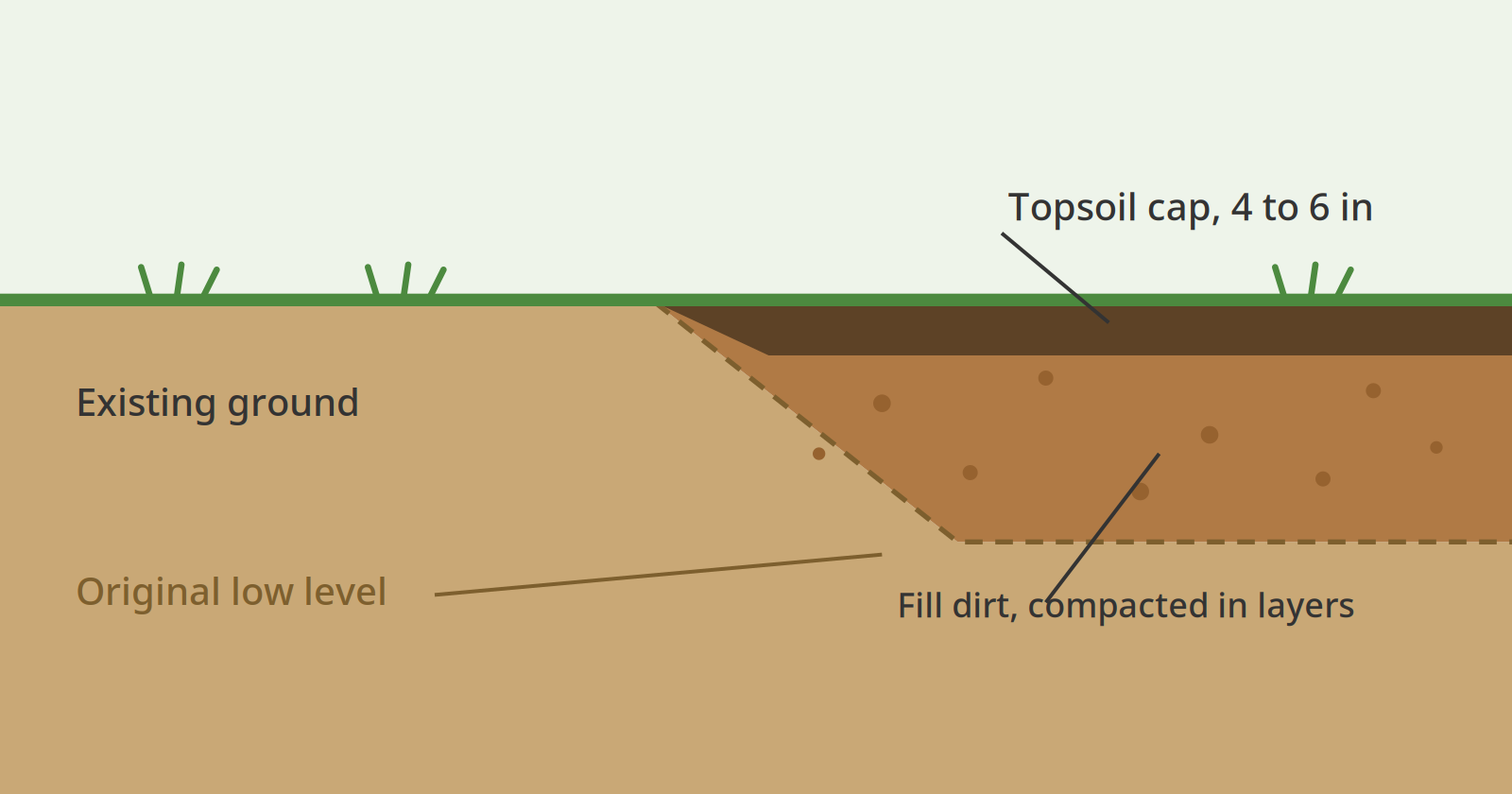
Raising a low corner of the yard, filling in an old pond, levelling ground for a shed: every one of these jobs starts with the same question, and the honest answer is that fill dirt is the easiest material to under-order. The hole always looks smaller than it is, and loose dirt shrinks once it is spread and packed down. This guide works through the measurement, the compaction allowance that catches most people out, and how the answer translates into tons and truckloads. If you would rather skip the arithmetic, the Fill Dirt Calculator runs the same numbers with your own measurements.
The short answer
Multiply the length by the width by the depth, all in feet, then divide by 27 to get cubic yards. Then add a compaction allowance on top: 15 percent for a typical levelling job, up to 25 percent for deep fills or clay-heavy soil. A patch 20 feet by 15 feet filled 6 inches deep works out to 5.6 cubic yards before compaction, and about 6.4 cubic yards to actually order. One cubic yard of fill dirt weighs roughly 1.2 tons, and a standard dump truck carries 10 to 14 cubic yards, so most home projects are a single load or less.
| Area | 3 in deep | 6 in deep | 12 in deep |
|---|---|---|---|
| 100 sq ft | 0.9 yd³ | 1.9 yd³ | 3.7 yd³ |
| 250 sq ft | 2.3 yd³ | 4.6 yd³ | 9.3 yd³ |
| 500 sq ft | 4.6 yd³ | 9.3 yd³ | 18.5 yd³ |
| 1,000 sq ft | 9.3 yd³ | 18.5 yd³ | 37.0 yd³ |
These figures are the settled volume, the amount that stays in the ground. What you order needs the compaction allowance added, which the next sections explain.
The fill dirt formula, step by step
Start by measuring the area in feet. Irregular shapes are easier as two or three rough rectangles added together than as one complicated outline. Depth is the judgement call: if the ground slopes, measure the shallowest and deepest points and use the average, because dirt orders are placed on the average fill across the whole area.
With length, width and depth in feet, the formula is:
Cubic yards = Length × Width × Depth ÷ 27
Depth given in inches needs converting first: divide inches by 12, so 6 inches becomes 0.5 feet and 4 inches becomes 0.33 feet. The 27 is simply the number of cubic feet in a cubic yard. Run the figures through the Fill Dirt Calculator if you have several areas to add up, since it totals them and applies the compaction allowance for you.
Compaction: why the ordered amount is bigger than the hole
Fill dirt arrives loose. Once it is spread, levelled and rolled or rained on, it packs down into a smaller volume than the pile that came off the truck. Order exactly the measured volume and the finished level sits low, which is why suppliers and contractors add a shrinkage allowance:
- Sandy or granular fill compacts about 10 to 12 percent.
- Mixed screened fill compacts about 15 percent, the safe default for most yards.
- Clay-heavy fill can shrink 20 to 25 percent, especially when it is machine-compacted in layers.
Deep fills deserve the allowance most. Anything deeper than about 8 inches should go down in layers (lifts) of 6 to 8 inches, with each layer wetted and compacted before the next, otherwise the whole depth settles unevenly over the following year and the dip comes back.
Worked example: levelling a 30 by 20 foot dip
Say one corner of the lawn sits low and collects water. Measured out, the low area is roughly 30 feet by 20 feet, and the depth runs from nothing at the edges to about 10 inches at the lowest point, so an average depth of 6 inches is a fair planning figure.
- Volume settled: 30 × 20 × 0.5 = 300 cubic feet, ÷ 27 = 11.1 cubic yards.
- With a 15 percent compaction allowance: 11.1 × 1.15 = 12.8, so order 13 cubic yards.
- Weight: 13 × roughly 1.2 tons = about 15.5 tons, which matters if the supplier prices by the ton.
- Truckloads: 13 yards fits in one standard dump truck load (10 to 14 yards), so delivery is a single trip.
Because the corner will finish as lawn, the last 4 to 6 inches should be topsoil rather than fill, so the grass has something worth rooting into. Order the fill at 13 yards minus that topsoil cap, and size the cap with the Topsoil Calculator. The same layering applies when the hole being filled is an old swimming pool, which is covered in the guide on filling in a pool with dirt.
Bags, bulk, or a truckload?
Fill dirt is a bulk material through and through. It is sold loose by the cubic yard or ton, and bagged dirt (usually labelled topsoil or garden soil, in 1.5 cubic foot bags) works out many times the price per yard: a full cubic yard is 18 of those bags. Bags only make sense for a wheelbarrow-sized repair under about a quarter of a yard. From half a yard upward, a bulk delivery is cheaper and far less handling, and most suppliers will tip it where you mark rather than at the kerb. If your figure lands between 1 and 3 yards, ask about the supplier's minimum load and delivery fee before assuming two small loads beat one bigger one; the delivery charge is often the same either way.
Fill dirt is not topsoil
The two get confused constantly, and the mix-up causes real problems. Fill dirt is subsoil: mostly mineral material with very little organic matter, which is exactly why it holds its shape, compacts well and does not rot down and sink. Topsoil is the dark, living layer plants grow in, and it settles and decomposes if it is buried deep. Build the grade with fill, cap it with 4 to 6 inches of topsoil anywhere grass or planting is planned, and never use topsoil as deep fill or fill dirt as the growing layer. If the project is mainly a new lawn rather than a hole to fill, start from Guide 4, How Much Topsoil Do I Need?, instead.