 Yard
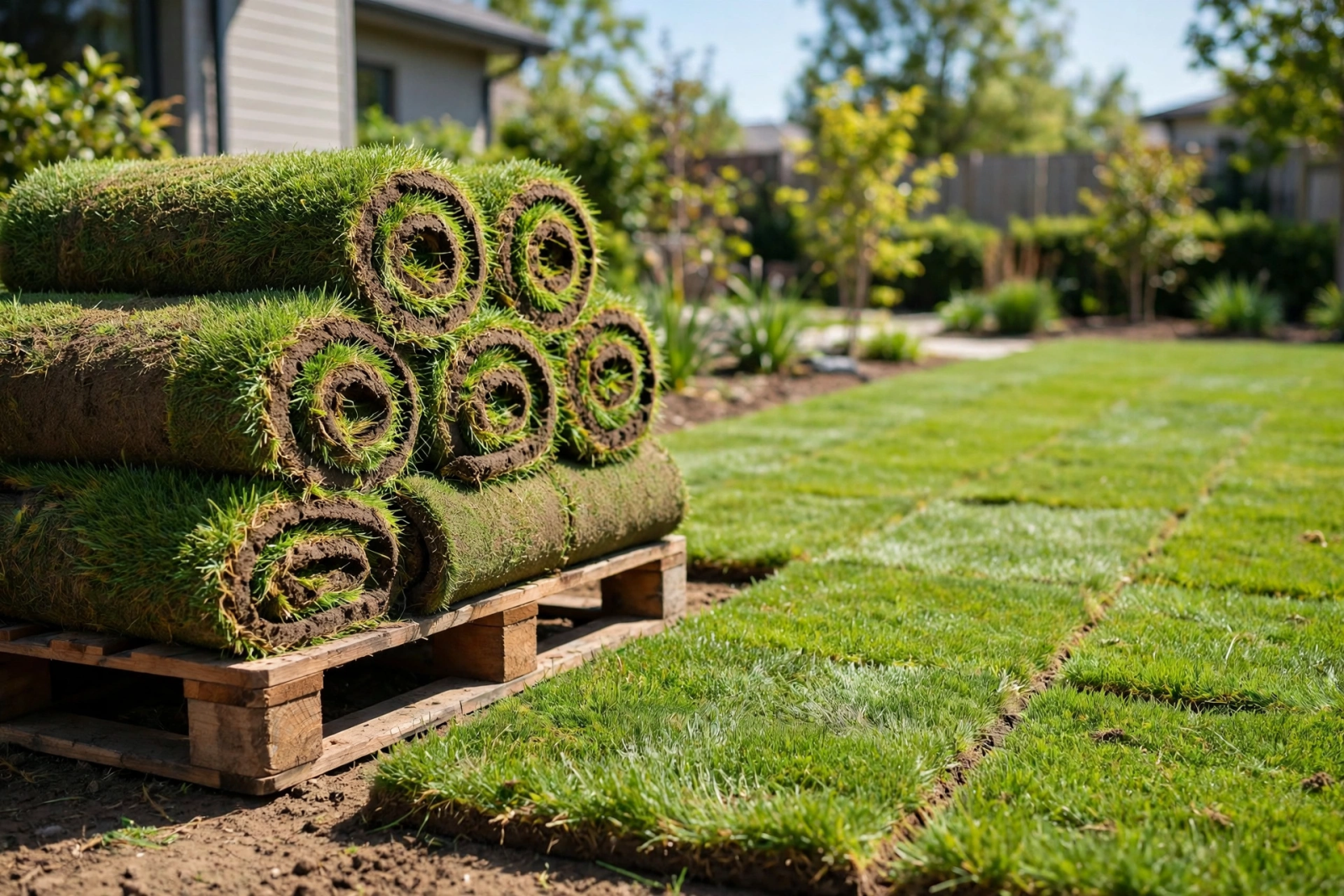
A new lawn lives or dies on the order. Too few rolls and the crew stands around while you ring the supplier for a second delivery; too many and the leftovers bake on the driveway. Sod is priced by the square foot but delivered in rolls and pallets, so the number you actually phone in needs one conversion more than most people expect. This guide does the arithmetic: how big a roll is, what a pallet covers, how much extra to allow for cuts, and how to measure a yard that is not a tidy rectangle. If you want the number in one step, the Sod Calculator takes your measurements and returns the square feet, rolls and pallets together.
The short answer
Measure the lawn in square feet, add a waste allowance for cutting (5 percent for a simple rectangle, 10 percent for a typical lawn, 15 percent for curved or sloped ground), then divide by 10 to get rolls of standard 2 by 5 ft sod, or by roughly 500 to get pallets. A 50 by 40 ft lawn, 2,000 square feet, needs about 2,200 square feet ordered, which is 220 rolls or 4.4 pallets. Confirm the pallet coverage with your supplier before you order, because farms stack anywhere from 450 to 600 square feet per pallet.
Lawn-size chart: rolls and pallets at a glance
The chart below adds a 10 percent waste allowance, the right figure for most lawns with a few beds and paths. If your yard is a plain rectangle with barely any cutting, you can shave a little off; if it curves and dips, add more.
| Lawn size | Order (with 10% extra) | Standard rolls | Pallets (~500 sq ft) |
|---|---|---|---|
| 500 sq ft | 550 sq ft | 55 | 1.1 |
| 1,000 sq ft | 1,100 sq ft | 110 | 2.2 |
| 1,500 sq ft | 1,650 sq ft | 165 | 3.3 |
| 2,000 sq ft | 2,200 sq ft | 220 | 4.4 |
| 3,000 sq ft | 3,300 sq ft | 330 | 6.6 |
| 5,000 sq ft | 5,500 sq ft | 550 | 11 |
| 10,000 sq ft | 11,000 sq ft | 1,100 | 22 |
Suppliers sell by the pallet or the roll, and not every farm sells half pallets. If your figure lands at 4.4 pallets, plan on 5 and put the spares along the edges, exactly where the day's offcuts would have gone anyway.
How the roll and pallet math works
A standard sod roll is 2 feet wide and 5 feet long, so one roll covers 10 square feet. A pallet holds roughly 50 of those rolls, which is where the round 500-square-feet figure comes from, but it is a convention rather than a standard: farms cut rolls at slightly different thicknesses and stack pallets anywhere from 450 to 600 square feet. Always ask the supplier what their pallet actually covers and do the last division with that number. The smaller slabs some farms sell, 16 by 24 inch pieces covering about 2.7 square feet each, are priced per piece and suit patch repairs, not whole lawns.
One more practical note: a pallet of sod weighs one and a half to two tons, so the order arrives by truck and comes off with a forklift. Decide the drop spot before the truck arrives, close to the laying area but off the soil you are about to plant into, because two tons of pallet compacts the ground it sits on.
Measuring a lawn that is not a neat rectangle
Split the yard into the simplest shapes you can and measure each in feet. Rectangles are length times width. Circles are the diameter squared times 0.785. Triangles are half the base times the height. An L-shaped lawn becomes two rectangles added together. For curved beds, take the tightest rectangle that contains the grass, then subtract the beds and paths inside it. Slopes deserve extra allowance: a bank measured flat on a plan has more real surface than the plan shows, so add a few percent more waste for hills.
Round every measurement up to the next whole foot. Sod cannot be ordered in fractions of a roll, and under-measuring by six inches across a 40-foot lawn costs you more in a second delivery than over-measuring ever will.
Worked example: a 50 by 40 ft lawn
Take a back garden that measures 50 feet by 40 feet, with a straight-edged bed along one side that is 10 feet by 8 feet.
- Grass area: 50 × 40 = 2,000 sq ft, minus the bed (80 sq ft) = 1,920 sq ft.
- Waste: a typical lawn with beds, so 10 percent: 1,920 × 1.10 = 2,112 sq ft to order.
- Rolls: 2,112 ÷ 10 = about 212 rolls.
- Pallets: 2,112 ÷ 500 = 4.2 pallets, so order four and a half if the farm sells them, otherwise 5 whole pallets.
The spare rolls from rounding up to whole pallets are not waste. They fill the strips along the fence where the day's offcuts came up thin, and a couple kept in the shade cover the patch you will inevitably scuff during the first month.
How much extra to allow for cutting
The extra is not padding; it is the material the cuts consume. Every curve, corner and obstacle turns a full roll into an offcut, and a surprising share of those offcuts are too small to reuse.
- 5 percent for a plain rectangle with straight edges and almost no cutting.
- 10 percent for the usual lawn, with a few beds, paths and trees to cut around.
- 15 percent for curved edges, slopes, narrow strips or heavy obstacles.
Set the allowance before you measure, not after, because it also absorbs the measuring errors every yard has. And resist the urge to run the number twice and take the smaller one: the second delivery for a forgotten strip costs more in delivery fees than those extra rolls would have.
When seeding is cheaper than sod
Sod wins on instant results, but the price per square foot is several times higher than seed. On very large areas, 10,000 square feet and up, or on ground that needs months of grading work before it is ready, seed is often the sensible route: it costs a fraction, it is forgiving about delivery timing, and modern cultivars establish fast. Size the seed with the Grass Seed Calculator before you commit to sod for a big project, and lay sod only where you need a finished lawn straight away, around the house and the paths.
Prepare the soil before the truck arrives
Sod goes down on prepared soil, never on bare subsoil or the old lawn, and the truck will not wait while you grade. Strip or kill the existing grass, level the ground, and spread 2 to 4 inches of good topsoil where the base is poor, sized with the Topsoil Calculator or Guide 4, How Much Topsoil Do I Need?. Book the delivery for the day after the soil is ready. Rolls stacked on a pallet heat up fast and start to yellow within a day in warm weather, so sod is a same-day material: morning delivery, laid by evening, watered deeply the moment it is down.