 Yard
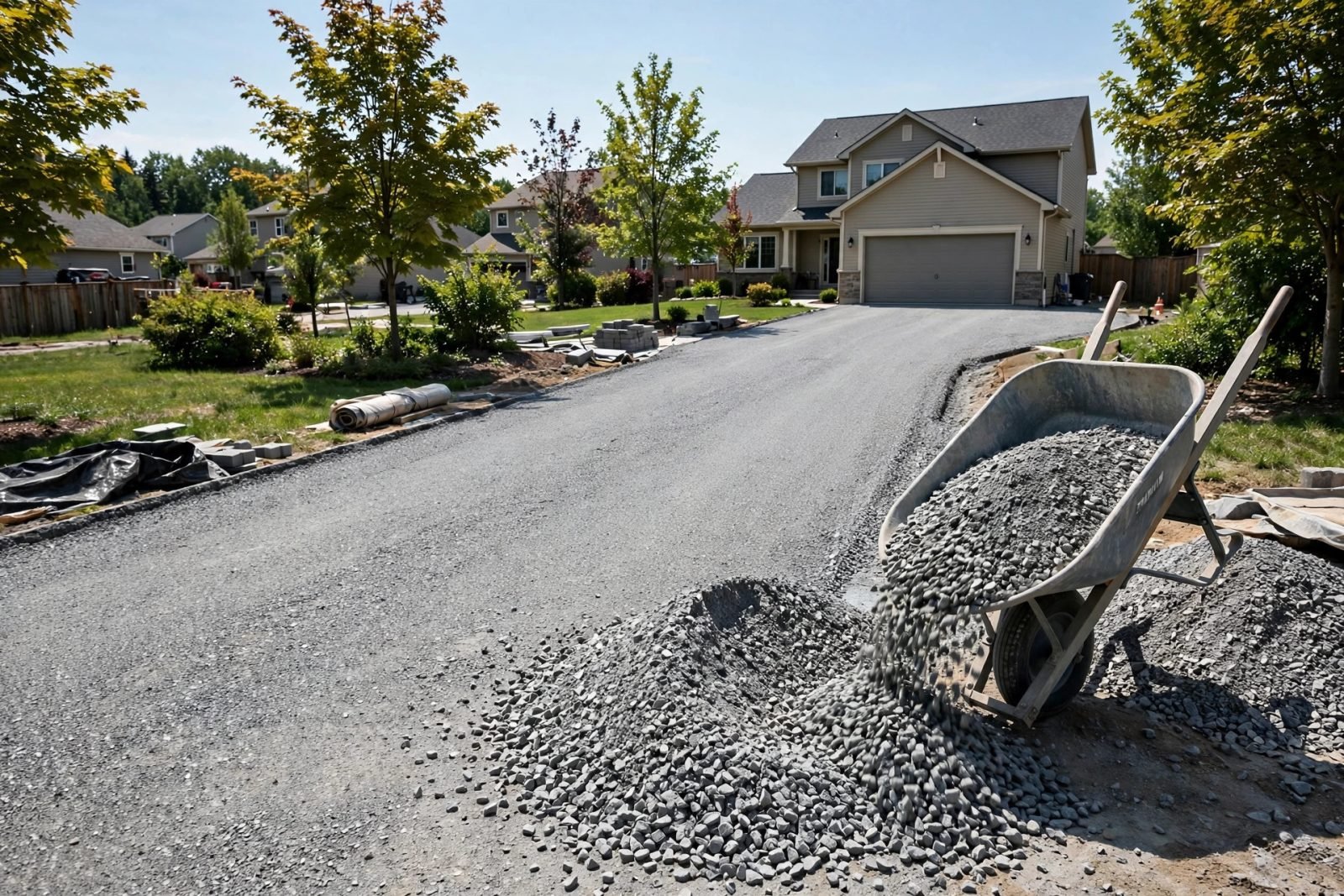
How much gravel you need, by driveway size
Most driveways are one of two jobs: topping up an existing driveway (a 3 inch fresh top layer) or building a new one from scratch (about 10 inches deep, in three compacted layers). Gravel weighs about 1.4 tons per cubic yard, so the table below gives you both numbers for the five most common driveway sizes:
| Driveway size | Top-up (3 in layer) | New build (10 in, layered) |
|---|---|---|
| 10 x 20 ft | 1.9 yd³ / 2.6 tons | 6.2 yd³ / 8.6 tons |
| 10 x 50 ft | 4.6 yd³ / 6.5 tons | 15.4 yd³ / 21.6 tons |
| 12 x 40 ft | 4.4 yd³ / 6.2 tons | 14.8 yd³ / 20.7 tons |
| 20 x 40 ft | 7.4 yd³ / 10.4 tons | 24.7 yd³ / 34.6 tons |
| 20 x 100 ft | 18.5 yd³ / 25.9 tons | 61.7 yd³ / 86.4 tons |
Your driveway is not in the table? Run your own length and width through the gravel calculator and get your exact cubic yards and tons in seconds. Suppliers take you more seriously when you already know your number.
The 3 layers, and what each one costs you in stone
A new gravel driveway is not one thick pile of stone. It is three compacted layers, and each layer is a separate part of your order:
- Base layer, 4 to 6 inches of large stone such as #3. This is the biggest, cheapest part of the order, and it carries the weight of the whole driveway.
- Middle layer, 3 to 4 inches of crushed stone such as #57, which locks the base together and helps drainage.
- Top layer, 2 to 3 inches of crusher run, compacted and crowned so water runs off to the sides instead of pooling.
Together the three layers add up to about 10 inches, which is where the "new build" column in the table above comes from. The gravel driveway layers guide walks through each layer, compaction and crowning in detail.
Why depth changes everything
People usually get the length and width right and the depth wrong. Gravel needs are volume, and volume scales with depth: on the same 10 x 50 ft driveway, a 3 inch top-up needs about 4.6 cubic yards while a new 10 inch build needs about 15.4, more than three times as much. The most common mistake is ordering for a top-up and getting a driveway that needs a rebuild. The formula is simple: length x width x (depth in inches / 12) / 27 = cubic yards, then multiply by 1.4 for tons.
Worked example: a 12 x 40 ft driveway, new build
Say your driveway is 12 ft wide and 40 ft long, and you are building from bare soil. That is 480 square feet.
- Total volume. 480 x (10 / 12) = 400 cubic feet, which is 14.8 cubic yards. At 1.4 tons per cubic yard, that is about 20.7 tons.
- Layer by layer. Base, 5 inches of #3 stone: 480 x (5 / 12) = 200 ft³, or 7.4 yd³. Middle, 3 inches of #57 crushed stone: 480 x (3 / 12) = 120 ft³, or 4.4 yd³. Top, 2 inches of crusher run: 480 x (2 / 12) = 80 ft³, or 3.0 yd³. The three layers add back up to 14.8 yd³, so the order checks out.
- Delivery reality. A tandem dump truck carries roughly 10 cubic yards per load, so this job is two loads. Ordering full loads avoids short-load surcharges, which is why the maths matters before you call. The bag vs bulk guide shows when bags stop making sense entirely.
One nuance on the top layer: crusher run is denser than general gravel (about 1.8 tons per cubic yard instead of 1.4), so that 3.0 yd³ top layer will weigh a little over 5 tons rather than 4.2. Round up, not down, on the heavy stone.
What it costs, briefly
Stone itself typically runs $25 to $50 per ton in the US, so the material for a new 10 x 50 ft build lands around $540 to $1,080. But the stone is only part of the bill: delivery per load, geotextile fabric and edging all add up. The full breakdown, per ton, per truckload and per finished driveway, is in the gravel driveway cost guide.