 Yard
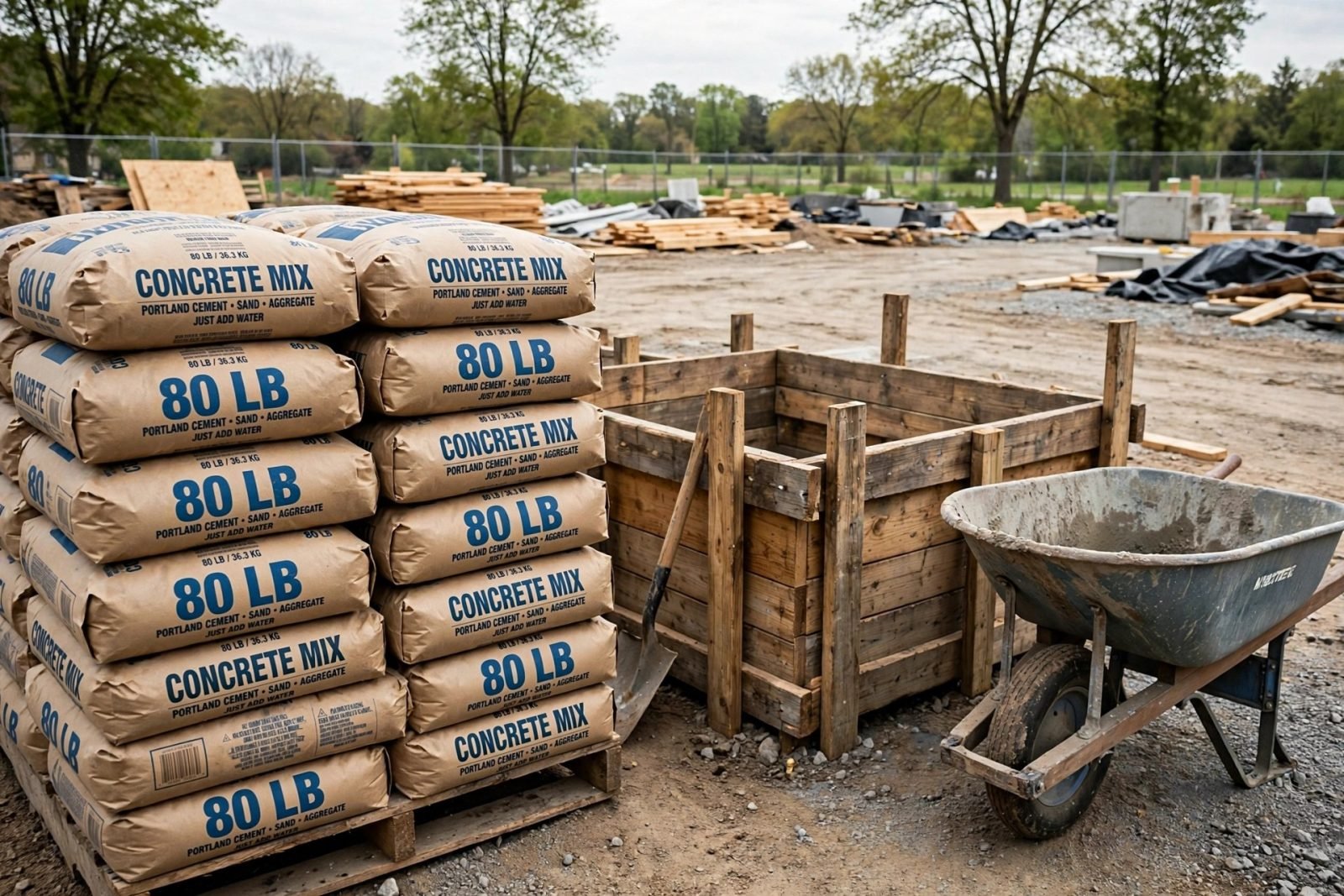
Bags of concrete by slab size (4 in thick)
Concrete bags are not all the same size, and that is where most wrong orders start. A standard 80 lb bag yields about 0.60 cubic feet of mixed concrete. The formula never changes: bags = volume in cubic feet / bag yield, then round up. For the six most common slab sizes at the standard 4 inch thickness, the maths is already done:
| Slab size | 80 lb bags | 60 lb bags | 40 lb bags | 80 lb, order this (+10%) |
|---|---|---|---|---|
| 4 x 4 ft | 9 | 12 | 18 | 10 |
| 6 x 6 ft | 20 | 27 | 40 | 23 |
| 8 x 8 ft | 36 | 48 | 72 | 40 |
| 10 x 10 ft | 56 | 75 | 112 | 62 |
| 10 x 12 ft | 67 | 89 | 134 | 74 |
| 12 x 12 ft | 80 | 107 | 160 | 89 |
The middle columns are exact, rounded up, with no waste allowance. The last column adds the 10% you should actually order on a prepared subgrade, because running short mid-pour is the one mistake that cannot be undone. Your size is not in the table? The concrete calculator does the same maths for any dimensions in seconds.
What each bag size actually yields
Every major brand follows the same industry-standard yields, but the bag sizes multiply fast when you price a job:
| Bag | Yield per bag | Bags per cubic yard | Best for |
|---|---|---|---|
| 80 lb | 0.60 cu ft | 45 | Slabs and big jobs; cheapest per cubic foot, but a genuine lift |
| 60 lb | 0.45 cu ft | 60 | Solo work; slightly pricier per yard, far easier to carry and dump |
| 40 lb | 0.30 cu ft | 90 | Small repairs, post holes and patches; minimises waste on tiny jobs |
| 50 lb fast-setting | 0.375 cu ft | 72 | Fence and mailbox posts; sets in 20-40 minutes, no mixing needed |
The 80 lb bag wins on price per yard and loses on your back. For anything you will mix by hand on your own, the 60 lb bag is the practical compromise, and the difference per yard is small enough to ignore. Always check the yield printed on your specific bag before you order; it wins over any table if it differs.
When the slab is thicker (10 x 10 ft reference)
Four inches is the standard for patios, walkways and shed floors, but driveways and anything carrying vehicles want 5 to 6 inches over a compacted gravel base. Here is what thickness does to the classic 10 x 10 ft slab:
| Thickness | Cubic yards | 80 lb bags | 80 lb, order this (+10%) |
|---|---|---|---|
| 3.5 in | 1.08 | 49 | 54 |
| 4 in | 1.23 | 56 | 62 |
| 5 in | 1.54 | 70 | 77 |
| 6 in | 1.85 | 84 | 92 |
Every extra inch on a 10 x 10 slab is roughly 14 more 80 lb bags. That is why depth mistakes are expensive: guessing 4 inches and pouring 5 leaves you a dozen bags short, which is a second trip to the store or a delayed pour. For a thicker slab you also need a thicker gravel base underneath, which the gravel calculator sizes for you.
Not a slab? Post holes, pads and walkways
Half of all bagged concrete goes into jobs that are not slabs. These four cover most of them, using the same bags / yield formula:
| Project | Size | 80 lb bags (order) |
|---|---|---|
| Fence post hole | 12 in diameter x 36 in deep | 4 (or 7 of the 50 lb fast-setting bags) |
| Mailbox post | 12 in diameter x 24 in deep | 3 |
| Small pad | 3 x 3 ft, 4 in thick | 6 |
| Sidewalk section | 4 x 20 ft, 4 in thick | 45 base, order 49 |
Post hole maths: a 12 inch diameter hole is 1 ft across, so volume = pi x 0.5² x 3 ft deep = 2.36 cubic feet. Divide by 0.60 for 3.93, round up to 4 bags. With 50 lb fast-setting bags it is 2.36 / 0.375 = 6.28, so 7 bags. For posts the fast-setting mix is usually the better buy even though it costs more per bag: no mixing, and the post is set in under an hour.
Worked examples
Example A: a 10 x 10 ft patio, 4 inches thick. Volume = 10 x 10 x (4 / 12) = 33.33 cubic feet. Bags of 80 lb: 33.33 / 0.60 = 55.5, round up to 56. With the 10% waste allowance: 56 x 1.10 = 61.6, so order 62. That is also 1.23 cubic yards, which is the number to use if you price the same job as ready-mix.
Example B: six fence posts, 12 in diameter holes 36 in deep. Each hole is 2.36 cubic feet, so 4 bags of 80 lb per hole, 24 bags total. Switching to 50 lb fast-setting bags: 7 bags per hole, 42 total, with no mixing and posts set the same afternoon. Either way, measure your actual holes first: a sloppy 14 inch hole in soft soil can swallow double the concrete a neat 12 inch hole takes.
When to stop buying bags: the ready-mix break-even
Bags are practical up to about 1 cubic yard, which is 45 eighty-pound bags. Past that, hand-mixing turns slow and the first batches start curing while you are still mixing the last, which is exactly how cold joints happen. A ready-mix truck is normally cheaper per yard above that line, far faster, and the mix is consistent from wheelbarrow to wheelbarrow.
The gray zone is 1 to 3 yards. Ready-mix plants often enforce 3 to 4 yard minimums and charge short-load fees below that, so if you have the labour and a mixer, bags can still win on cost in that window. The decision rule: under half a yard, bags, no question; half a yard to 1, bags unless the store run is a problem; 1 to 3, price both ways including the plant's short-load fee; over 3, ready-mix almost always wins. A standard mixer truck carries 8 to 10 cubic yards and delivers in quarter-yard increments, so the maths scales cleanly either way.
Cost anchors (US, 2026, regional, not quotes): an 80 lb bag runs about $8 at the store. The 10 x 10 example above is 62 bags, roughly $496 of bags. The same 1.23 yards as ready-mix lands around $460 to $720 depending on region and short-load fees, minus the hours of mixing labour you get back. The bag vs bulk guide runs the same kind of per-yard comparison for gravel and soil if you are ordering both.